Designing Trust Into a Kids’ Clothing Swap
Mini Swap
How a single Instagram story turned swapping kids’ clothes into a trusted, scalable product, built around what parents told me they actually needed.
Summary
For the past ten years, I’ve spent four or five hours every six months sorting, purging, buying, and reorganizing my son’s closet. When he was five, I inherited a bundle of barely-worn clothes from my family from coveted brands like Janie and Jack, Carter’s, and J.Crew’s crewcuts. He outgrew them in six months, and donating perfectly good clothes felt awful. So I posted an Instagram story: could another mom use a 5T bundle? Within a day I’d matched with a mom whose son was growing into exactly that size. I shipped the box, and that was it.
Style-conscious parents already swap clothes through group chats, friend circles, and hand-me-down networks. The behavior is proven. What’s missing is the infrastructure: a trusted way to find style-matched families beyond your personal circle, and a fair way to exchange without money changing hands.
I led UX discovery and product design for the Mini Swap MVP, a peer-to-peer kids’ clothing exchange built on a credit economy. Listing earns credits; credits unlock claiming. No cash, no negotiating, no lowball offers.
The feature set was shaped by six in-depth parent interviews, backed by broader community signal: around fifty replies in a 26,000-member parenting Facebook group, plus a steady stream of Instagram messages and comments. Nothing was added speculatively. Every decision in the MVP, from a hard photo to quality gating traces back to something a real parent said.
The Problem
To understand what was actually blocking parents, I started with the people closest to the problem. I ran six in-depth interviews with parents who already swap clothes informally including: a NYC curator mom running her own network, a budget-disciplined mom in New Orleans, an eco-conscious seller in Seattle juggling Poshmark, Mercari, and donation bins, and others. To pressure-test how widespread the pain was, I read through roughly fifty replies in a 26,000-member parenting Facebook group and a stream of Instagram messages and comments. The parents I spoke to didn’t want another resale marketplace.
“I have a whole system with my friend group, but I’d love to find more families who dress their kids the same way we do.”
— Natalie N., NYC parent, research participant
Key Insights
Trust is the real gatekeeper | Special items have nowhere worthy to go |
Every parent described a version of the same fear: the “Goodwill dump bag.” Receiving tattered or surprising items from a stranger, with no way to vet condition or cleanliness beforehand, was enough to block them from claiming at all. | High-cost, low-use items feel too precious to donate and too niche to sell. Parents wanted these to go somewhere they’d be worn and appreciated, not dropped in a bin. |
The core tension was clear: parents didn’t need more clothes or more listings. They needed trust, a fair exchange, and a worthy home for clothes their kids outgrew.
Mapping the Journey
I mapped the full swap end-to-end, from family profile to rating a completed exchange and cross-checked each stage against the research. The friction clustered at three moments: listing a bundle, claiming from a stranger, and the trust gap after the swap. Those clusters are where the MVP’s key features came from.
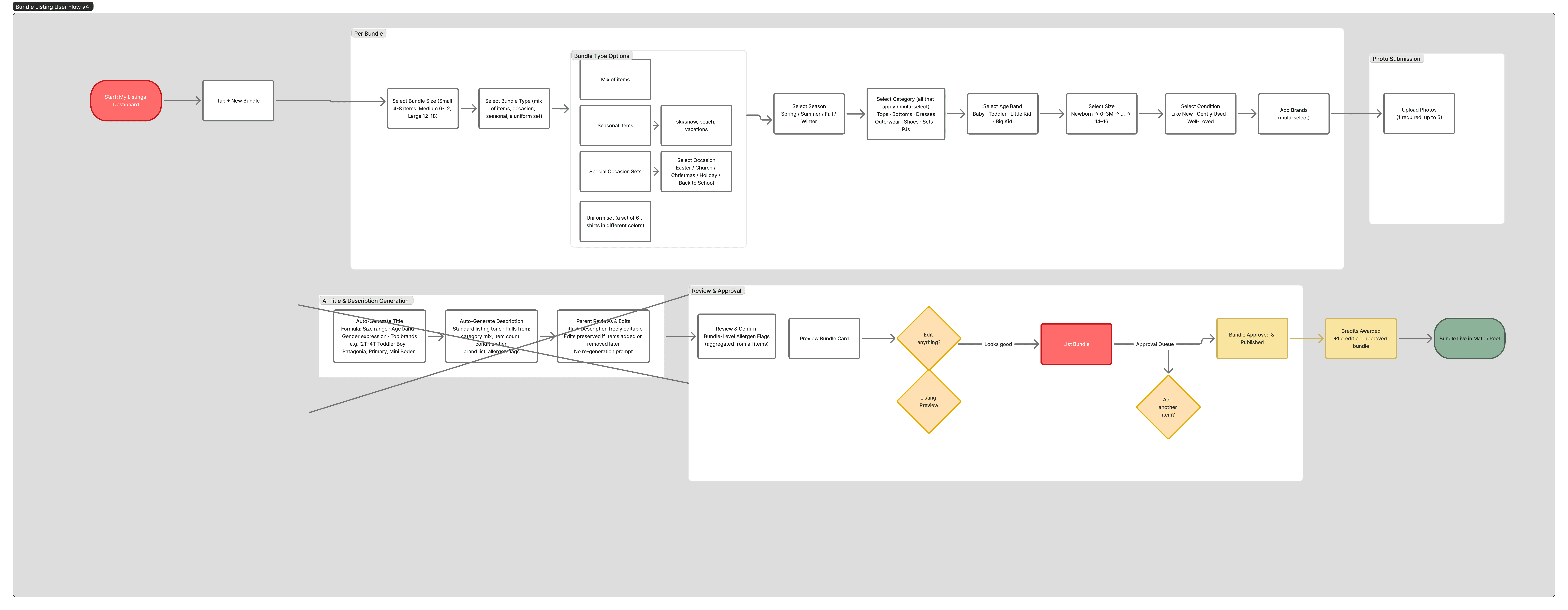
Reading the journey this way kept the feature list tight. Each stage earned its features by exposing a specific friction point.
Stage | Where it broke down | The feature it drove |
|---|---|---|
List | “What counts as a good bundle, and what am I supposed to photograph?” | The four-tier credit system and listing standards that price curation, not volume. |
Match | Wrong-season, wrong-style noise eroded trust in the feed fast. | Matching on size, style, brand, and climate, plus a Special Occasion category and shelf. |
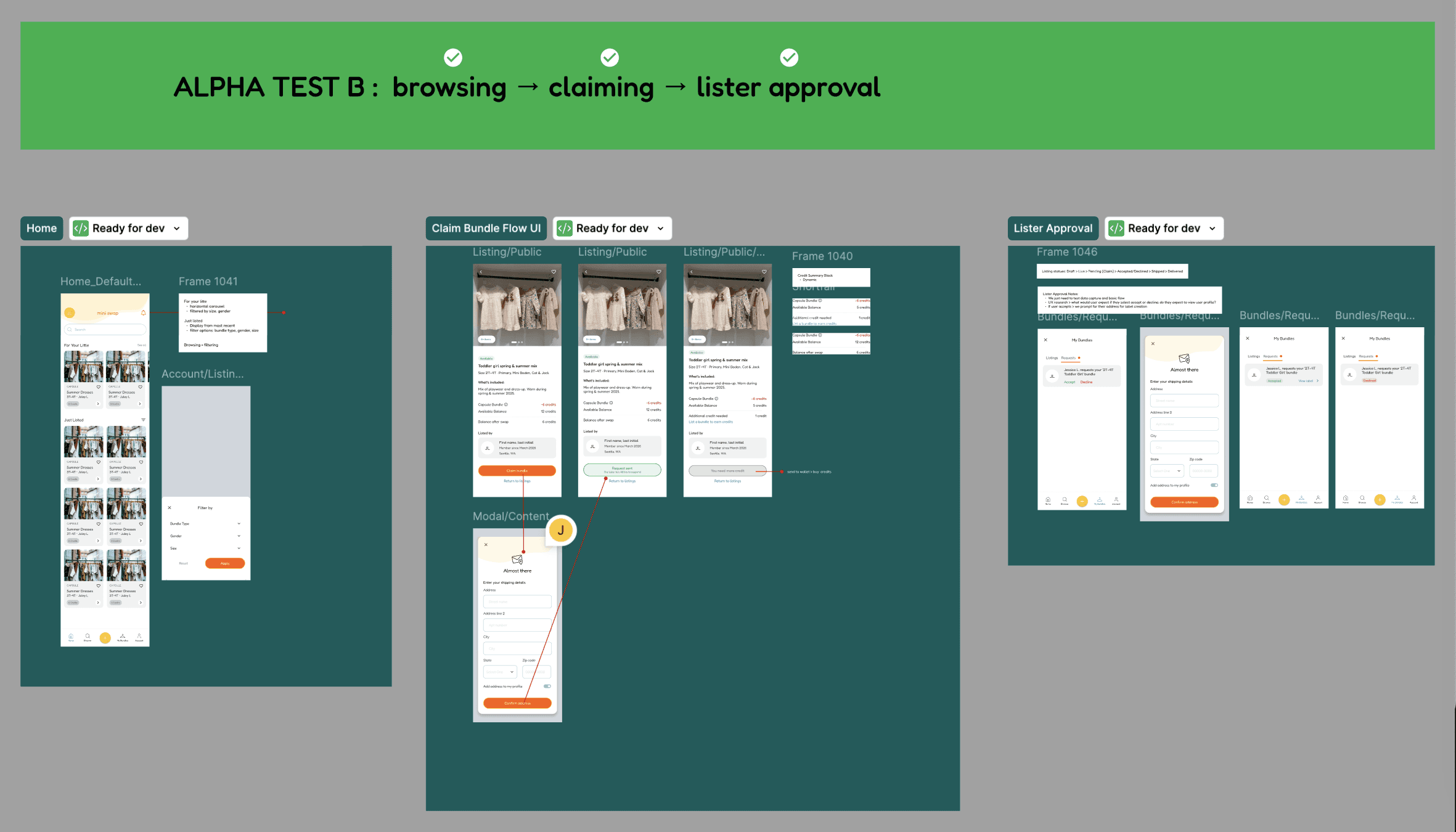
Claim | Committing to a stranger’s bundle without vetting contents first. | A hard photo gate, full item grid and internal approval process. |
Ship | The “vessel problem,” label cost, and a nagging sense of whether the trade was even. | Prepaid labels and credits rewarded upon delivery confirmation. |
Rate | After the swap, nothing captured the one signal parents cared about most: trust. | Lister ratings to inform quality and and satisfation. |
The claim stage stood out as the single point where a hesitant parent either trusts the system or abandons it. That’s why the densest cluster of trust features lives there, and why I treated it as the center of gravity for the design work that followed.
My approach
A swap economy only works if the exchange feels fair to both sides, and if listing well is genuinely rewarded over dumping a bag of mixed items.

Bundles are priced by curation effort. A thoughtfully assembled six-item Capsule is worth more than an unsorted sixteen-item Haul, which aligns the lister’s incentive directly with the claimer’s experience.
My working hypothesis: if exchange feels fair and every item is visible up front, parents will trust strangers enough to swap, and the special pieces they’ve been hoarding will finally move.
Designing the Experience
From a strategic standpoint, I wanted the act of claiming from a stranger to feel as safe as swapping with a friend. That meant designing the trust signals into the core flow.
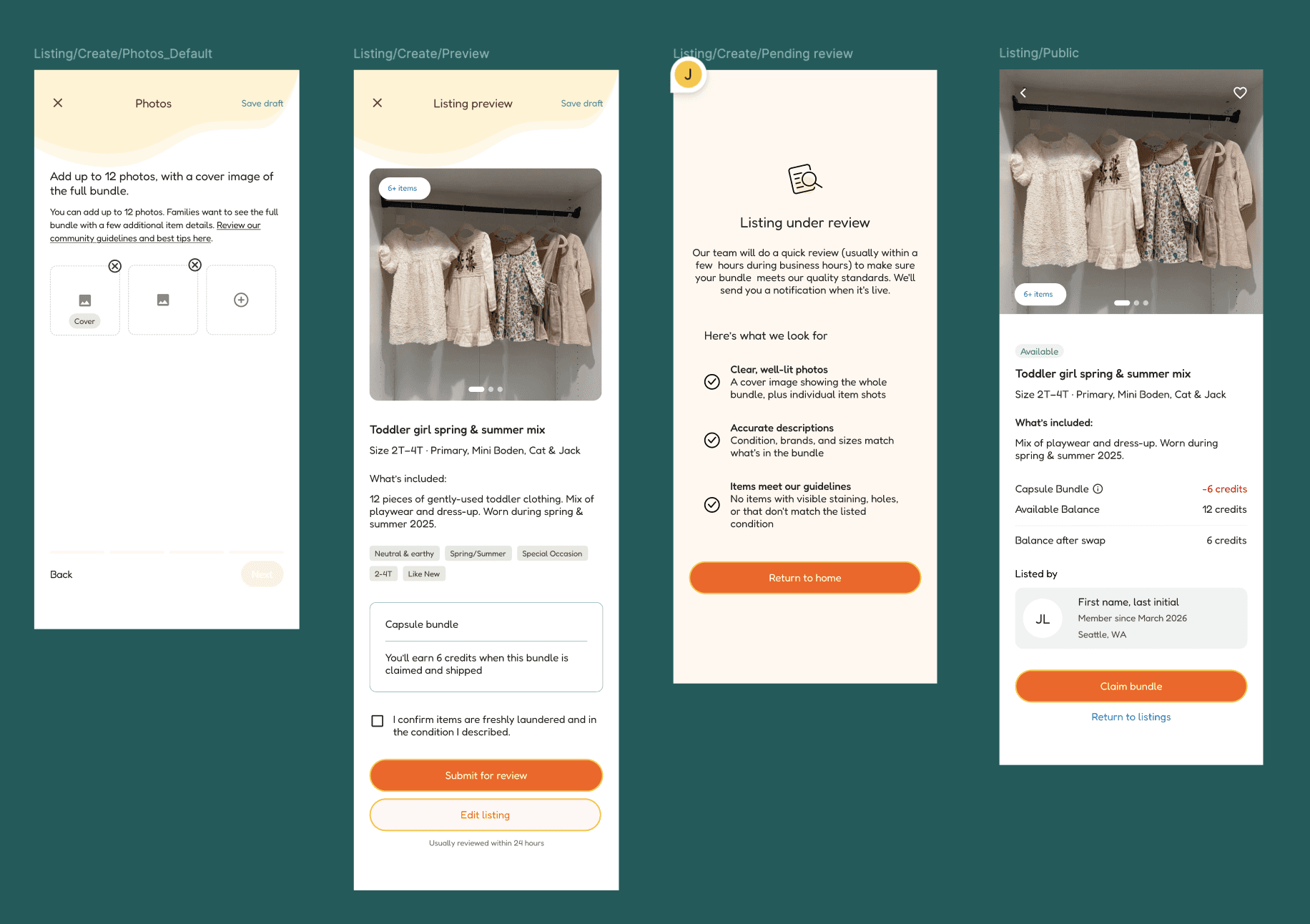
First, a hard photo gate: no bundle goes live without a full photo of the bundle. The “Goodwill dump bag” fear dissolves when you can see exactly what you’re getting.
Second, we added an approval step that makes our evaluation visible. Every listing is reviewed for accuracy, quality, and cleanliness before it goes live, with an honor-system "freshly washed" checkbox at submission. This one came from my technical cofounder, who flagged the risk of unmoderated user-generated content early. It's deliberate friction: it guards against inappropriate or low-quality listings and signals to parents that we hold listings to a real standard. The fastest way to lose this audience is to flood their feed with mismatched, low-effort bundles. For an MVP, a lightweight review gate was the most pragmatic way to protect a community in its earliest, most fragile stage.
Third, I deprecated the “swaps” framing internally in favor of credits. Swaps stays the friendly, user-facing unit, while credits do the accurate accounting underneath.
I mapped the full flow from listing, through matching, to claim and ship and pressure-tested each tier rule and trust mechanism against the research before committing them to the spec.
Where It’s Headed
Mini Swap is in active development heading into launch, so the current version of this section is about the bets, not the receipts yet. The design is built to be measured against a clear set of launch targets tied to a specific design assumption, so we’ll learn fast whether the trust-first thesis holds.
What we’re watching (90 days post-launch) | Target |
|---|---|
Repeat swap rate within 60 days | ≥40% |
Average rating on completed swaps | ≥4.2 / 5 |
Capsule + Treasure share of listings | ≥30% |
Free → Community Plus conversion | ≥8% of active users |
Credit-pack purchase rate among free users | 25%+ within 60 days |
What I take from this project: when a behavior already exists, the design job isn’t to invent demand. It’s to remove the specific frictions keeping it small. For Mini Swap, that friction was trust, and almost every design decision is an answer to it.